
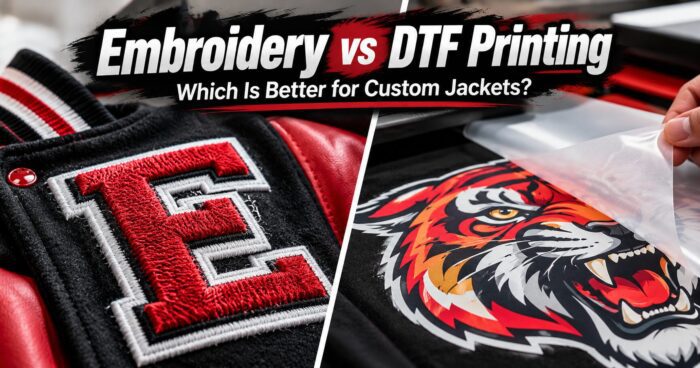
When ordering custom jackets, one of the most important decisions is how your logo, name or artwork should be applied to the garment.
Two common options are embroidery and DTF (Direct-to-Film) printing.
Both can produce attractive results, but they are very different in appearance, durability, artwork capability and cost. At Eraine Clothing, we use both methods depending on the jacket design, logo size, fabric, order quantity and the result the customer wants to achieve.
This guide explains the differences between embroidery vs DTF printing for custom jackets and when each method is more suitable.
What Is Embroidery?
Embroidery creates a design by stitching coloured threads directly onto the garment or onto a separate patch.
It is one of the most established decoration methods for jackets, uniforms and corporate apparel.
Embroidery is commonly used for:
- Company logos
- Chest logos
- Personalised names
- Sleeve logos
- School and university emblems
- Club or association logos
- Small to medium-sized artwork
- Embroidered patches
Because the design is made with thread, embroidery creates a textured and dimensional finish rather than a printed layer sitting on the fabric surface.
See Computerised Embroidery in Production
This short video shows computerised embroidery being produced directly onto the garment.
What Is DTF Printing?
DTF stands for Direct-to-Film.
The artwork is printed onto a special film and then transferred onto the garment using heat and pressure.
DTF is particularly useful for artwork containing:
- Many colours
- Small details
- Gradients
- Complex illustrations
- Photographic-style graphics
- Large designs
- Fine text and shapes
Unlike embroidery, DTF produces a flatter printed surface rather than a stitched texture.
Embroidery vs DTF Printing: What Is the Difference?
Neither technique is automatically better for every custom jacket. The right method depends mainly on the artwork, required appearance, expected usage and budget.
| Feature | Embroidery | DTF Printing |
|---|---|---|
| Appearance | Textured and dimensional | Flat, smooth printed finish |
| Durability | Generally very durable | Good, but normally less durable than embroidery |
| Small logos | Excellent for suitable artwork | Excellent |
| Large artwork | Possible, but can become heavy and expensive | Very suitable |
| Fine details | Limited by stitch size | Very suitable |
| Gradients | Difficult to reproduce accurately | Excellent |
| Many colours | Possible, depending on artwork | Easy to reproduce |
| Corporate branding | Excellent | Suitable depending on artwork |
| Photographic artwork | Not suitable | Suitable |
| Large complex artwork cost | Usually higher | Often more economical |
When Should You Choose Embroidery?
Embroidery is usually the better option when you want a durable and professional finish.
It works particularly well for logos that are relatively simple and do not contain excessive fine detail.
Common examples include:
- Company logos on the chest
- Staff names
- Department names
- School emblems
- University logos
- Small sleeve logos
- Corporate branding
- Club badges
For uniforms and jackets that may be worn regularly over a long period, embroidery is often preferred because the stitched design is highly durable.
When Should You Choose DTF Printing?
DTF printing is useful when artwork would be difficult, impractical or expensive to reproduce with embroidery.
Examples include:
- Large back graphics
- Detailed illustrations
- Multi-colour artwork
- Gradients
- Fine detailed lettering
- Complex event graphics
- Artwork with many separate elements
DTF can reproduce designs that would require a very high stitch count if embroidered, making it a practical option for some large or highly detailed graphics.
Is DTF Printing as Durable as Embroidery?
DTF printing can provide good results when it is correctly applied and properly cared for.
However, embroidery generally has a longer service life because the design is stitched into the garment.
A heat-transferred print is exposed to stretching, washing, heat and friction during use. Over time, the printed surface may show wear sooner than a properly embroidered design.
For this reason, we consider how the jacket will be used before recommending a decoration technique.
For example, a jacket intended for an event or promotional campaign may have different requirements from a corporate or work jacket that will be worn regularly.
Does Embroidery Always Look Better?
Not necessarily.
Embroidery provides a textured and professional appearance, but some artwork simply works better as printing.
A detailed illustration containing shading, gradients and many small elements may lose important details when converted into embroidery.
A very large embroidered design can also become:
- Heavy
- Stiff
- Expensive
- Less comfortable
- Difficult to reproduce accurately
In these situations, DTF may produce a better visual result.
The decoration method should follow the artwork rather than forcing every design into embroidery.
Can Large Back Logos Be Embroidered?
Yes. Large back embroidery is possible, but the size and complexity of the artwork need to be evaluated first.
A large design may require a very high number of stitches, increasing production time, cost, weight and stiffness.
For some of our custom jacket projects, a back embroidery around 30 cm wide is already considered a large decoration. The final suitable size depends on the artwork and garment construction.
For very detailed or highly colourful artwork, we may instead recommend:
- DTF printing
- Embroidered patch
- Appliqué embroidery
- A combination of embroidery and printing
Embroidery vs DTF for Varsity Jackets
Custom varsity jackets often use several decoration techniques on a single garment.
For example:
- Front chest: embroidery or embroidered patch
- Sleeve: embroidery, patch or appliqué
- Back: embroidery, appliqué or DTF
- Personalised name: embroidery or patch
This means you do not have to choose only one decoration technique for the entire jacket.
For a varsity jacket with a detailed large back graphic, we may recommend embroidery for the smaller logos and DTF for the larger artwork.
Embroidery vs DTF for Corporate Jackets
For custom corporate jackets, embroidery is generally our first option for small company logos.
It provides a clean professional finish and is suitable for regular use.
However, DTF may be more appropriate when:
- The logo contains gradients
- The artwork has very small details
- A large design is required
- The branding contains many colours
The final recommendation should be based on the artwork rather than simply the type of jacket.
Can Embroidery and DTF Be Combined?
Yes. In fact, this is often the best solution for complex custom jackets.
For example:
- Company logo: embroidery
- Sleeve badge: embroidered patch
- Large back artwork: DTF
- Personalised name: embroidery
Using different techniques allows each part of the jacket design to be produced using the method most suitable for that artwork.
There is no requirement for every logo on one jacket to use the same decoration method.
What About Embroidery Patches, Chenille and Appliqué?
Embroidery and DTF are not the only decoration options available.
Depending on your design, we can also produce:
- Embroidery patches
- Chenille embroidery and chenille patches
- Appliqué embroidery
- DTF patches
- Silkscreen printing
These methods can be especially useful when creating varsity-style graphics, badges, large lettering or designs that require a different texture.
See our Garment Decorations guide for examples of the different embroidery, patch and printing methods available.
Does Embroidery Cost More Than DTF?
It depends on the artwork.
Embroidery cost can be influenced by:
- Logo dimensions
- Stitch count
- Number of embroidery positions
- Artwork complexity
- Order quantity
A small simple logo may be very practical to embroider. However, a large and detailed design can require a high stitch count and therefore become substantially more expensive.
DTF pricing is generally more closely related to print size, artwork and quantity.
This is why comparing embroidery and DTF prices without first seeing the actual artwork can be misleading.
Which One Should You Choose?
Choose Embroidery If:
- You want long-lasting decoration
- You need professional corporate branding
- Your logo is small or medium-sized
- You require personalised names
- You prefer a textured appearance
- You want embroidered patches
Choose DTF Printing If:
- Your artwork contains many details
- You need many colours
- Your design contains gradients
- You have a large graphic
- You need fine details
- You have illustration-style artwork
- Embroidery would result in an excessive stitch count
Use a Combination If:
Your jacket contains several types of artwork with different requirements.
In many projects, combining techniques produces the best balance between appearance, durability and cost.
Send Us Your Artwork Before Deciding
You do not have to decide between embroidery and DTF before requesting a quotation.
Send us:
- Your logo or artwork
- Jacket design or reference
- Required quantity
- Logo positions
- Approximate logo sizes
- Personalised names, if applicable
- Delivery location
Our team can review the design and recommend whether each element is better produced using embroidery, DTF printing, appliqué, patches or a combination of techniques.
Get a Quotation for Custom Jackets
Eraine Clothing produces custom jackets and apparel for companies, schools, universities, organisations, clubs and other bulk-order customers.
Our customisation options include embroidery, DTF printing, embroidered patches, appliqué and other decoration methods.
Final pricing depends on the quantity, garment specification, material, decoration method, artwork size and number of decoration positions.
For an accurate quotation, send us your design and requirements and we can recommend a suitable production method.